Applications of spatial water isotope data to basic and applied science
Hydrology:
- Stable water isotopes provide an incredibly useful tool for establishing
connectivity of water resources. Hydrologists and hydrogeologists have been using water isotopes
as a component of mixing and recharge models for decades, and a variety of intellectual and
practical applications have been developed. Spatial analysis of water isotope data in a GIS
environment, however, is a new endeavor, and current developments in this area are well-timed to
take advantage of the recent emphasis on catchment to basin-scale hydrology. Our work has
involved studies of the geospatial distribution of surface water (Dutton et al., 2005) and tap
water (Bowen et al., 2007) isotope ratios to
investigate the hydrological connectivity between water resources and hydro-climatic sources.
(Paleo)climatology:
- Studying the modern geospatial and temporal distribution of precipitation water
isotopes can improve our understanding of how features of the climate are represented in water
isotope data. Two approaches can be applied: we can study the static representation of mean
climatic patterns in modern water isotope data to understand what salient features of the
climate system are recorded, or we can study temporal patterns in stable water isotope
distributions to understand what climate phenomena strongly affect water isotope ratios. I am
pursuing both approaches in my work, with an emphasis on representation of climate seasonality
(Bowen, 2008) and atmospheric circulation in
spatial stable isotope fields.
 Geospatial interpretation of paleo-archive proxy data for water isotope ratios
is still in its infancy. Increased understanding of the features of the modern spatial fields of
water isotope ratios and recent advances in the analysis of H and O isotopes in organic
compounds should lead to developments in this field over the next 5 years.
Geospatial interpretation of paleo-archive proxy data for water isotope ratios
is still in its infancy. Increased understanding of the features of the modern spatial fields of
water isotope ratios and recent advances in the analysis of H and O isotopes in organic
compounds should lead to developments in this field over the next 5 years.
Ecology:
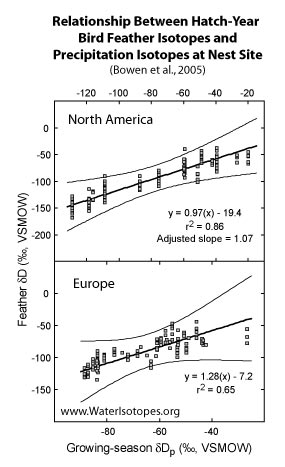
- Stable water isotopes are increasingly used in wildlife forensics studies, most
commonly in studies of animal migration. A number of important studies have been published since
1997. My work has explored the basic premise that information on the geographic origin of
migrant animals is recorded in the stable water isotope composition of their body tissues, and
developed guidelines for applying this method in wildlife forensic studies. This work is
described in two papers published in Oecologia. In the first, we use a new dataset of
hydrogen and oxygen isotopes in European bird feathers to investigate the potential for
identifying the wintering sites of European migrant birds using stable isotopes, with reference
to spatial water isotope grids created using a variety of methods (Hobson et al., 2004). In the
second, we adopt a broader focus, presenting the first global maps of growing season water
isotope values and describing how they can be used to statistically constrain the location of
origin of animal or plant samples (Bowen et al., 2005). We have applied these methods to study the
migratory (Bearhop et al., 2005) and the dietary
ecology of Pleistocene raptors (Fox-Dobbs et al.,
2006).
Forensics:
- The use of hydrogen and
oxygen isotope ratios as forensic tracers of biological tissues, foods, and manufactured
materials has exploded in recent years. Body tissues like human hair and tooth enamel serve as an archive of information on a person's
life and travel history. Research is ongoing to develop generalizable models and isoscapes
describing the spatial patterns of water isotopes in such tissues. Increasingly, these
approaches are being translated to practice. Companies like Oritain, FloraTrace, and Eurofins are working with governments and corporations to use water
isotope data to trace the origin of foods and other products. Independent researchers and
practitioners are both developing and providing expert advise -
for example, through my consulting company Bowen Scientific, I work with law enforcement agencies, companies, and
attorneys to support isotope applications. The growing isotope forensics community is supported
through a professional organization, the Forensic
Isotope Ratio Mass Spectrometry Network, which organizes conferences, provides training
and accrediation programs, and issues best practices guidelines for isotope forensics.